
November 9, 2026
System Design: A Short-Form News Feed for a Caribbean Newsroom
A little while ago I talked with a news broadcaster in the Caribbean about building a short-form news feed for their country. Think vertical videos like TikTok or Reels, mixed with quick text stories, all coming from their own reporters. The project didn't end up going ahead, but the problem stuck with me. On the surface it looks like a TikTok clone. Once you dig in, it turns out to be a pretty different system, and most of the interesting decisions come from where it's being built rather than what it is.
So here's how I'd design it.
What they wanted
The idea was simple. Open the app, and you get the country's news as a feed. Short videos from reporters on the scene, and short written stories for things that don't need video. Breaking news goes to the top and can send a push notification. Everything comes from the newsroom's own team, not from users.
That last part matters more than it sounds, and I'll come back to it.
The constraints that actually shape the design
Before thinking about servers, I'd write down what makes this place different from Silicon Valley, because those constraints drive almost every decision.
Data is expensive. A lot of people in the region are on prepaid mobile plans, where every megabyte costs real money. A feed that autoplays high quality video is basically a feed that eats your phone credit.
Connections are uneven. Good 4G in town, patchy coverage in rural areas, and everything gets worse during storms. Reporters in the field deal with the same thing when they try to upload.
The audience is small, but it spikes hard. A small country might have under a million people, and on a normal day only a slice of them open the app. But when a hurricane warning goes out, or there's an election, or something big happens, nearly everyone opens it at the same moment. That includes the diaspora. Huge numbers of people from the Caribbean live in the US, Canada, and the UK, and they check home news constantly, especially when family is in the path of a storm.
The team is small. A regional newsroom isn't going to have a platform team. Whatever I build has to be run by one or two engineers, and it can't need someone awake at 3 a.m. to keep it alive.
And hurricane season is a real design input, not an edge case. Power cuts, damaged cell towers, and a newsroom that might be working from wherever they can find a signal.
What this is not
It's worth saying what we don't need, because it makes the whole thing a lot simpler than it looks.
There's no user-generated content. Every story comes from a reporter the newsroom employs, so there's no upload flood, no moderation pipeline, and no spam problem. The newsroom publishes maybe a few dozen stories a day. TikTok gets millions of uploads.
There's no recommendation engine either. When your whole catalog for the day fits on one screen, you don't need machine learning to decide what to show. Newest first, with breaking news pinned to the top and editors able to pin important stories, is what people actually want from a news app. It's also easier to trust, which matters for a news organization.
So the hard parts aren't where TikTok's hard parts are. Writing is small and easy. Reading is spiky and has to be cheap. That split shapes the whole design.
Some rough numbers
Let's assume a country of about a million people, and that 100,000 of them, plus diaspora, use the app on a normal day. Each person watches around 15 clips, and a clip is about 45 seconds.
Here's the part that surprised me when I worked it out. A 45 second vertical video at a decent 720p quality, around 2 Mbps, is roughly 11 MB. At a lower 360p setting, around 600 kbps, it's about 3.4 MB. At 240p, it's under 2 MB.
So 15 clips a day at 720p is about 165 MB per person per day. At 360p, it's around 50 MB. For someone on a small prepaid bundle, that difference decides whether they keep using the app.
It matters for the broadcaster too. 100,000 people watching 15 clips at 360p comes out to about 5 TB of video served per day, around 150 TB a month. Meanwhile, storing everything the newsroom produces in a year is maybe a couple hundred gigabytes. Storage is basically free here. Bandwidth is where the money goes, and it's the same thing the viewers are paying for on their end. Making video smaller helps both sides at once.
The publishing side
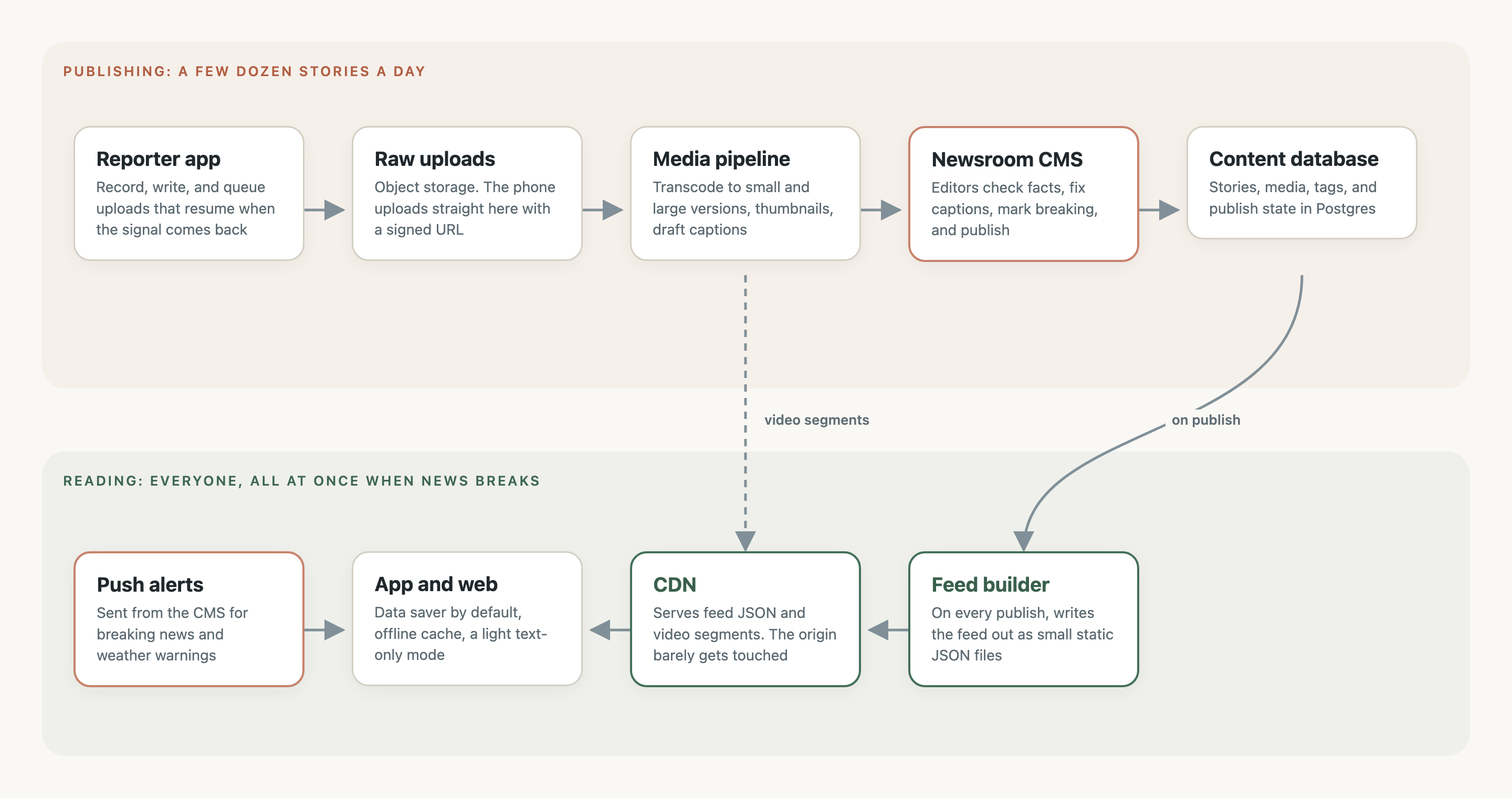
Reporters get a simple mobile app to record video or write a short story, then send it to the newsroom. The tricky part is the upload. A reporter standing next to a flooded road might have one bar of signal. So uploads go in chunks and pick up where they left off if the connection drops, instead of starting over. The app uploads straight to cloud storage using a signed URL, so the servers never have to handle big video files themselves.
For breaking news, I'd add one trick. Upload a small, low quality version first so editors can review it and publish quickly, then upload the full quality original in the background, or later on wifi. The story goes live in minutes, and the better version swaps in when it arrives.
Once a video lands, a media pipeline takes over. It converts the video into several sizes, from a small 240p version up to 720p, cuts it into short segments for streaming, makes a thumbnail, and generates a first draft of captions with speech-to-text. Captions matter a lot here, since most people scroll with the sound off. But speech-to-text tends to struggle with local accents, and a lot of the region speaks a Creole or patois that these models handle poorly. So the captions are a draft, and an editor fixes them before publishing.
Then everything goes into a newsroom CMS. Editors check the story, fix the captions, add tags like weather or politics, mark it as breaking if needed, and hit publish. Stories, media links, and publish state live in a regular Postgres database. Nothing fancy, because at a few dozen stories a day, it doesn't need to be.
For the video pipeline, I'd start with a managed video service instead of running my own transcoding servers. It costs more per minute of video, but with one or two engineers, not having to babysit a video pipeline is worth a lot. If volume grows later, you can bring it in-house.
The reading side
This is where the real design work is.
The key idea: everyone in the country sees basically the same feed. There's no personalization to compute per user. So instead of having a server build the feed every time someone opens the app, I'd build it once, every time a story is published, and save it as small static JSON files on a CDN.
The newest stories go into one file, something like latest.json, with the 20 or so most recent items. Older stories go into archive files by date. Once a day is over, its archive file never changes again, so the CDN can cache it forever. Only latest.json changes, and when a story is published, the feed builder rewrites it and tells the CDN to drop the old copy. A feed page looks something like this:
{
  "generated_at": "2026-11-09T08:15:00Z",
  "older": "/feed/2026-11-08.json",
  "items": [
    {
      "id": "st_8f21",
      "type": "video",
      "headline": "Flash flood warning for the north coast",
      "breaking": true,
      "published_at": "2026-11-09T08:12:00Z",
      "duration_s": 42,
      "poster": "https://cdn.example.com/v/st_8f21/poster.jpg",
      "stream": "https://cdn.example.com/v/st_8f21/master.m3u8",
      "captions": "https://cdn.example.com/v/st_8f21/captions.vtt",
      "tags": ["weather"]
    },
    {
      "id": "st_8f1c",
      "type": "text",
      "headline": "Parliament passes the new road budget",
      "summary": "Three changes drivers will notice this year.",
      "published_at": "2026-11-09T07:40:00Z",
      "tags": ["politics"]
    }
  ]
}
The whole thing is a few kilobytes once compressed. When news breaks and everyone opens the app at once, almost every request is answered by the CDN, and the servers behind it barely notice. The rush that would normally take a site down turns into a non-event. Topic filters like "only weather" can happen in the app itself, since all the data is already there.
The CDN also matters for where people are. A lot of internet traffic in the region already routes through Miami, and the diaspora is spread across North America and Europe. A CDN with servers in those places means a fast feed for everyone, whether they're in the capital or in Brooklyn checking on their mom.
Being careful with people's data
In the app itself, I'd make data saving the default, not a hidden setting. On mobile data, videos start at the lowest quality and only go up if the connection is good, which is exactly what adaptive streaming is built for. Autoplay only loads the first couple of seconds until someone actually stops to watch. Larger downloads, like preloading the next few videos, only happen on wifi.
The app would also keep the last day or so of stories cached on the phone. If you lose signal, you can still read what you already loaded. Text stories are tiny, so they can always be saved for offline reading.
I'd also make every story a lightweight web page that loads fast without the app, with a good preview image and headline. In the Caribbean, a lot of news travels through WhatsApp groups, so a story shared in a family chat needs to open instantly on any phone. For a lot of people, that shared link will be their first contact with the product.
Push alerts
Breaking news and weather warnings go out as push notifications. People subscribe by topic, so someone can get hurricane alerts without getting every sports score. With an audience this size, sending to everyone takes seconds, so the technical side is easy. The hard part is editorial. Too many alerts and people turn them off, and then they miss the one that actually matters. So I'd put a limit on how many non-emergency alerts can go out per day, the same rate limiting idea from my last post, just aimed at the newsroom instead of at attackers.
Hurricane mode
This is the part I'd test hardest, because it's when the app matters most and when everything around it is failing.
First, the servers shouldn't be on the island. Everything runs in cloud regions outside the hurricane zone, so a storm that knocks out local power doesn't knock out the app. The CMS is a web app, so editors can publish from any laptop or phone with a connection, even if they can't reach the newsroom.
Second, there's a lite mode. When editors switch it on, the app and website show a text-only version of the feed with the latest updates, shelter locations, and emergency numbers. It's a single tiny page that loads even on a weak 2G connection. In an emergency, a short paragraph that loads in two seconds beats a video that never finishes buffering.
And because the feed is already static files on a CDN, the traffic spike from everyone checking at once is the one thing I'm not worried about. That's the payoff of the earlier decision.
What I'd build first
With a small team, I wouldn't build all of this on day one. I'd start with the CMS, text stories, video through a managed service, and the static feed on a CDN, shown in a mobile-friendly website instead of native apps. That's enough to find out whether people actually use it. Native apps, push alerts, and the reporter app would come next. Hurricane lite mode would ship before the first hurricane season, no matter what else was on the list.
Wrapping up
What I like about this problem is how much of the design comes from the setting instead of from the technology. A short video feed is a solved problem in general. A short video feed for a small island, where people pay for every megabyte, the audience shows up all at once, and the infrastructure might literally get hit by a storm, is a much more specific problem. Building the feed once instead of per request, defaulting to small video, and planning for the worst week of the year ends up being most of the design.
The project didn't happen, but I still think about it. Most of the interesting engineering in the world isn't happening at the scale of TikTok. It's happening in places where the constraints are different, and the job is to design for those constraints instead of copying what the big apps do.